
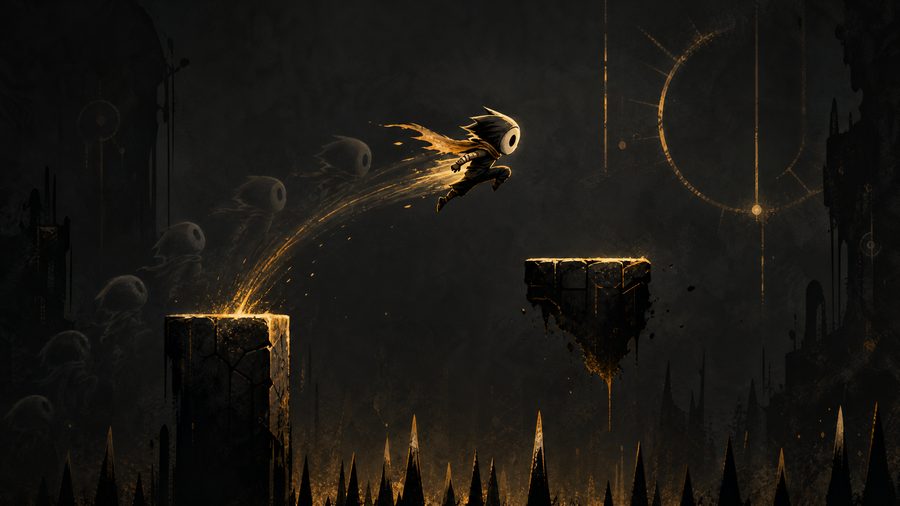
We spent a long time assuming that the important variable in a difficult game was the difficulty. Having now logged 4,912 attempts across 31 games, we are fairly confident the important variable is the retry loop, and Spire Of Glass is the strongest evidence for that claim.
The number is four tenths of a second, measured frame by frame from the death frame to the first frame accepting input. There is no death animation, no fade, no loading and no menu. The character reappears at the start of the room and the game is running again before you have finished registering the failure.
What that number does to 1,340 attempts
The arithmetic is simple and worth doing explicitly. At 0.4 seconds, 1,340 attempts cost nine minutes of waiting. At the 6.1 seconds we measured in Crowned Ash, the same 1,340 attempts would have cost two hours and sixteen minutes. At the 38 seconds we measured in Winterhold Run, it would be fourteen hours.
| Game | Retry loop | Attempts logged | Total waiting |
|---|---|---|---|
| Spire Of Glass | 0.4s | 1,340 | 9 minutes |
| Sigil Run | 2.2s | 486 | 18 minutes |
| Crowned Ash | 6.1s | 1,104 | 1 hour 52 minutes |
| Lantern Watch | 14s | 163 | 38 minutes |
| Winterhold Run | 38s | 94 | 59 minutes |
Crowned Ash is the better-designed game in almost every other respect and it cost us nearly two hours of watching animations. That is not a small tax on a player's time; it is the equivalent of an additional chapter spent doing nothing.
The ghost trail, which is the other half of the design
The retry speed alone would be admirable. What makes it instructive is that each failed attempt leaves a translucent ghost of its own path on screen, fading over roughly six seconds. When you die at the same point four times in a row, you can see four slightly different approaches overlaid, and the correction becomes visible rather than intuited.
We can measure the effect of this. In the six rooms where we deliberately turned the ghost trail off, our attempt counts rose by between thirty and seventy per cent for equivalent difficulty. The trail is doing genuine teaching work rather than decoration.
| Room | Attempts with trail | Attempts without | Increase |
|---|---|---|---|
| Room 14 | 23 | 31 | 35% |
| Room 22 | 41 | 58 | 41% |
| Room 29 | 17 | 29 | 71% |
| Room 33 | 62 | 81 | 31% |
| Room 37 | 38 | 54 | 42% |
| Room 41 | 84 | 119 | 42% |
A fast retry loop is not a convenience feature. It is the mechanism by which a difficult game teaches, and it is the first thing we now check.
Where the attempt curve behaves differently here
Our general finding is that learning stops around attempt forty and resumes only after a break. Spire Of Glass is the one game in our data set where that plateau is much shallower, and we think the trail explains it: because each attempt supplies new visible information, the fifteenth attempt is genuinely different from the fortieth in a way it is not elsewhere.
It is not eliminated, though. Room 41 took 84 attempts, and the log shows a clear flat section between attempt 45 and attempt 70 where nothing improved. Even the best retry loop in the world cannot fix fatigue, and we would still recommend stopping after thirty consecutive failures on anything.
Assist options, tested individually
Six options, each enabled alone for at least twenty attempts. This is the most complete set we have surveyed and it is worth describing in detail, particularly because none of them alter the challenge.
- Full input remapping. Every action rebindable including menus, with support for two simultaneous bindings per action.
- Ghost trail duration. Adjustable from off to twelve seconds. We recommend leaving it at the default six.
- Reduced motion. Removes parallax and background animation. Improves clarity in the later rooms considerably.
- High-contrast hazards. Renders spikes and moving hazards in a single flat colour. Genuinely useful and does not simplify anything.
- Input buffer window. Extends the window in which a queued input registers, from 2 to 8 frames. This is the one option that arguably touches difficulty, and the game says so plainly in its own description.
- Screen reader support for menus. Present and functional, which is rarer than it should be in this genre.
The game also keeps a per-room attempt counter of its own, visible in the pause menu. We used it to cross-check our manual log and it agreed with our count in every room but one, where we had missed three attempts. That transparency deserves credit.
Verdict
The strongest argument we can make that difficulty is a function of the retry loop rather than of challenge. Four tenths of a second between attempts, a ghost trail that measurably reduces attempt counts by thirty to seventy per cent, six properly implemented assist options and an honest in-game attempt counter. The plateau still exists in the hardest rooms, and nothing here helps you recognise it.